
Patients rarely complain about a 20-minute wait. They complain about a wait nobody told them about. A clinic that says "about 15 minutes" and delivers 20 gets fewer complaints than a clinic that says nothing and delivers 10 — the uncertainty is the actual problem, not the minutes. That reframes the fix: you're not trying to make consults faster (that's a clinical decision, not an operations one), you're trying to make the wait legible.
1. Say a number, even a rough one
"The doctor will call you shortly" tells a patient nothing they can plan around. "About 15 minutes" lets them decide whether to sit down, step outside, or ask a question. It doesn't need to be precise — patients forgive an estimate that's off by five minutes far more readily than they forgive silence.
2. Post the queue, not just the estimate
A patient who can see "2 people ahead of you" stops needing to ask the front desk whether they've been forgotten — which is most of what "how much longer?" interruptions actually are. A visible queue answers the question before it's asked.
3. Batch the questions reception asks at check-in
Every extra question at the check-in desk adds to the line behind that patient. Separate "needed to start the queue" (name, doctor) from "needed before the consult" (insurance, history) and only ask the first set at the counter. The rest can happen in the waiting room, on paper or a tablet, without holding up the line.
4. Use real numbers, not a fixed estimate
A flat "15-minute wait per patient" sign is wrong more often than it's right — some consults run five minutes, some run thirty. If the estimate is visibly wrong a few times a day, patients stop trusting it, which brings back every "how much longer?" question you were trying to avoid. The fix is to track how long today's consults have actually taken and estimate from that — which is exactly what a running average column in a spreadsheet does, automatically, for free.
5. Put it on a screen, not just at the desk
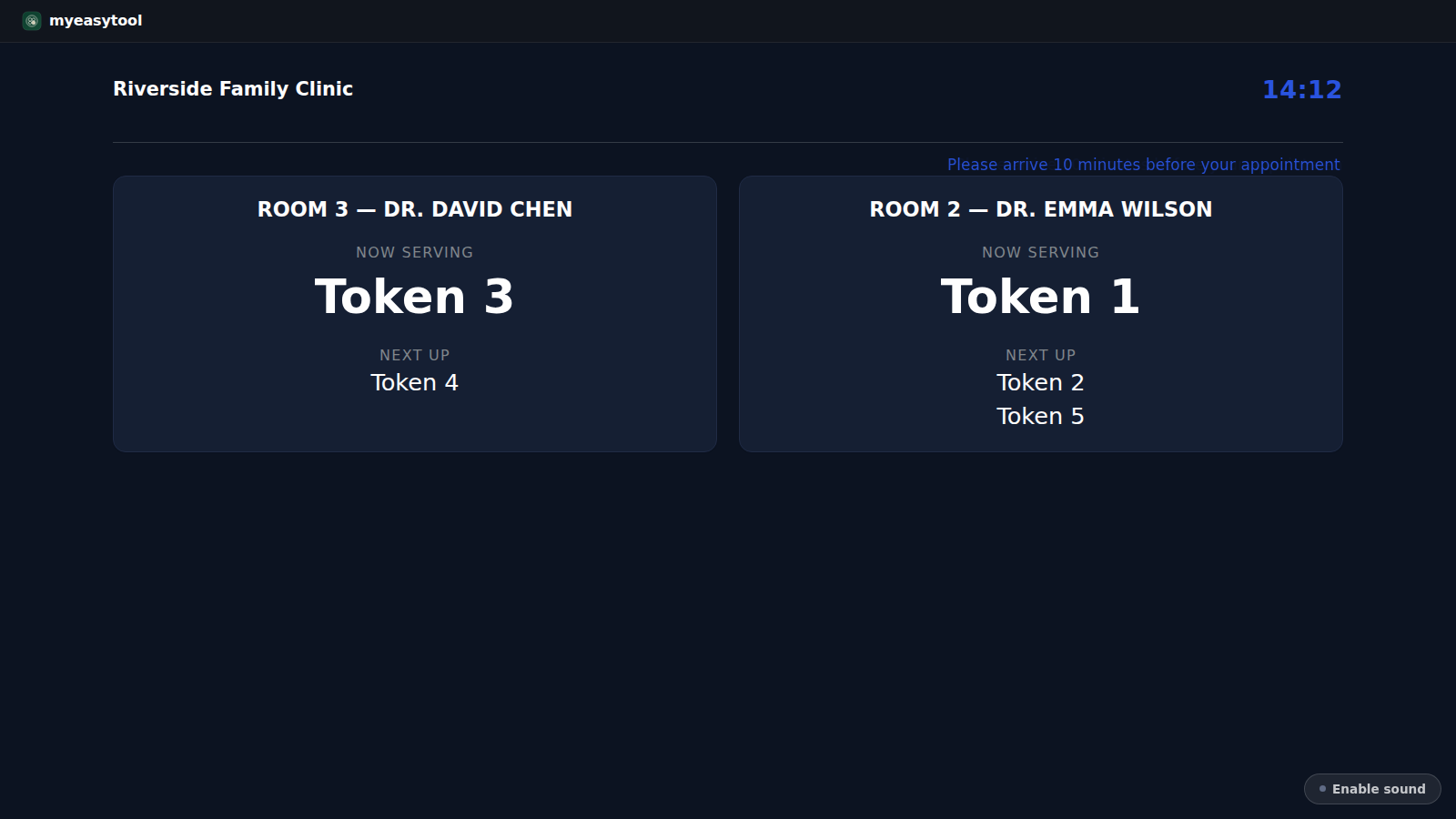
A waiting-room display — token number, not a name, by default.
A screen the whole waiting room can see does the work of a dozen "how much longer" answers at once. It doesn't need to show names — a token number is enough for a patient to track their own place, and it keeps things private in a room full of strangers.
We built exactly this as a genuinely free Google Sheet — no app, no Apps Script, no signup. Reception checks a patient in, the sheet learns each doctor's real average consult time today and estimates every wait from it, and a second tab is built to go on the waiting-room TV. See how it works, or start a free trial of the hosted version →
The trade-off worth knowing up front
A shared spreadsheet gets you most of the way there for free, and it's genuinely enough for a single-doctor practice running one shift. It starts to strain once multiple staff are editing the same rows at once, or once a display link needs to survive someone fat-fingering a formula on the front-desk laptop. That's the point where clinics we talk to move to a hosted version — same idea, same columns, just with roles that can't step on each other and a display link that can't be broken. Not a requirement, just the honest trigger.